Purchases through affiliate links with Counterflow Coffee Review may earn this site commission at no extra cost to the reader. Affiliate Funding Policy
If you want better coffee at home, upgrading your grinder delivers a far bigger improvement than buying a more expensive brewer. Brewing coffee is fundamentally an extraction process: hot water dissolves soluble flavor compounds from ground beans. How quickly and evenly those flavors extract depends directly on particle size and particle consistency, as explained in CoffeeGearHub's guide on grind size and extraction science.
When grounds are uneven, fine dust over-extracts and adds harsh bitterness, while larger boulders under-extract and leave sour, watery notes. Choosing the right coffee grinder comes down to three factors: the brewing method you use most often, your tolerance for manual effort versus electric convenience, and how precisely you need to adjust particle size.
Quick Selection Path
- For espresso or Turkish coffee on a budget: Choose a precision manual burr grinder or a dedicated compact stepless electric burr grinder capable of micro-adjustments.
- For daily drip, batch brew, or French press: An electric conical burr grinder with stepped settings provides fast, repeatable doses without hand-cranking.
- For single-cup pour-over or travel: A premium hand grinder with steel conical burrs offers high grind uniformity, zero motor noise, and minimal counter footprint.
- For general spices and casual dark roasts: An entry-level blade grinder is inexpensive, but lacks the particle consistency needed for balanced specialty coffee.
The Three Grinder Categories: How They Compare
As outlined by Kochere Coffee Co.'s breakdown of grinder families, home grinders fall into three practical designs: spinning blade units, hand-cranked burr mills, and motorized electric burr machines.
Manual Hand Grinders: Precision and Portability
Manual burr grinders have evolved dramatically. Modern hand grinders use machined steel burrs mounted on dual-bearing shafts, allowing you to produce a remarkably uniform particle spread without the motor expense or benchtop bulk of a commercial machine.
Because your budget goes entirely into the burr set and chassis rather than an electric motor, a quality hand grinder often matches or outperforms electric grinders costing twice as much when brewing pour-over or Aeropress. However, hand-grinding hard, light-roast beans for espresso takes physical effort and generally limits you to 20 to 30 grams per batch.
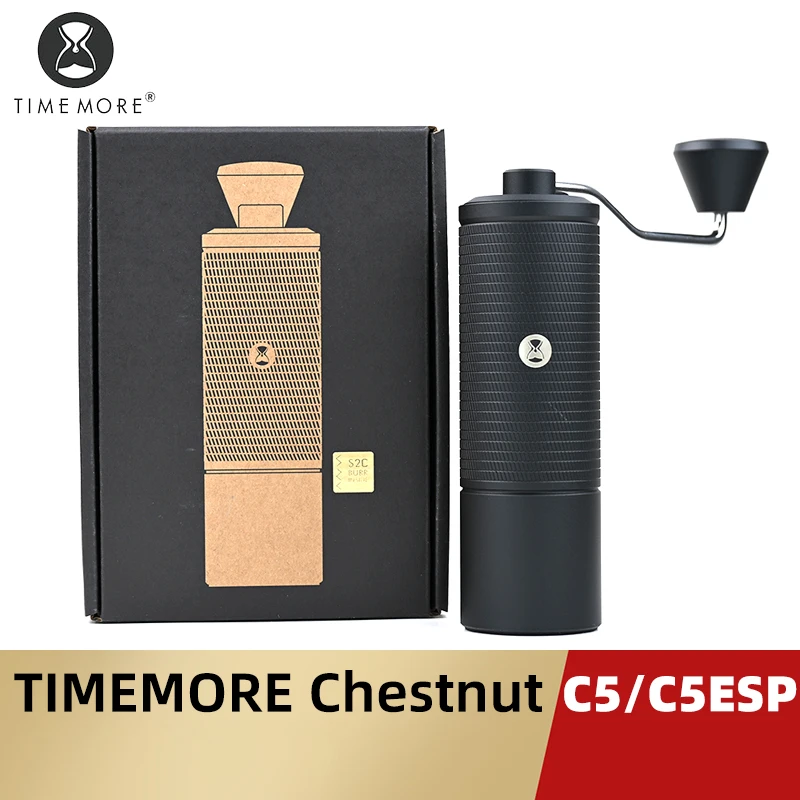
The TIMEMORE Chestnut C5 / C5 ESP series represents this modern manual category. Based on seller specifications, it features 42mm "Spike to Cut" (S2C) burrs designed to pre-fracture beans before finishing the cut, a 25g hopper capacity, and fine adjustment increments aimed at pour-over and espresso dialing. If you prepare single cups or travel frequently, a precision manual mill offers exceptional grind quality for the footprint, provided you do not mind cranking for 30 to 60 seconds per brew.
Electric Burr Grinders: Daily Convenience & Espresso Dialing
For most households, an electric burr grinder is the everyday workhorse. Instead of pulverizing beans, paired burrs crush them through a fixed gap. You adjust the fineness by moving the burrs closer together or further apart. Electric models fall into two distinct sub-types: hopper-fed batch grinders and single-dose compact grinders.
Batch Filter & Drip Grinders
Hopper grinders store several days of whole beans and use a timer or cup selector to dispense grounds into a bin. They excel at pour-over, automatic drip machines, and French press, where extreme micro-adjustability is less critical than repeatability and speed.

The Wancle Electric Burr Grinder targets this multi-cup filter workflow, listing 28 grind settings across fine, medium, and coarse brewing bands. For drip pots and immersion brewers, stepped presets make switching between brew styles straightforward. Before purchasing entry-level electric burr units, verify whether the listing voltage matches your regional outlet (such as 120V for North America or 220V–240V for Europe and Asia), as international marketplace sellers often offer regional electrical variants on the same product page.
Single-Dose & Espresso-Focused Electric Grinders
Espresso requires very fine particle sizing and minute flow adjustments. Traditional hopper grinders can retain several grams of stale grounds in the internal chute, making dialing in frustrating. Single-dose grinders solve this by grinding only the exact dose weighed into the hopper, using low-retention paths or bellows.

The HiBREW G5 is a dedicated single-dose machine equipped with a 48mm CNC-machined conical burr set according to official HiBREW product specifications. Designed with a tilted aluminum body and stepless adjustment collar, it is tailored for fine-spectrum brewing including espresso, moka pot, and Turkish coffee, alongside standard drip ranges. Because of its compact 50g hopper capacity and single-cup catch cup, it is ideal for espresso enthusiasts rather than families brewing full 10-cup drip carafes at once.
Blade Grinders: The Budget Compromise
Electric blade grinders operate like miniature blenders. A spinning metal blade strikes beans at high RPM, smashing them into uneven fragments. The longer the motor runs, the finer the overall pile gets—but the size distribution remains unpredictable.

Multi-purpose 4-blade units, like the Kitchen Multifunctional Grain & Coffee Chopping Grinder, offer a very low entry price and dual utility for grinding dried chili, seeds, spices, and grains. For coffee, however, the trade-off is significant: uneven extraction makes it difficult to eliminate astringency or sourness. If you already own or choose a blade grinder, pulse the power in short 2- to 3-second bursts while gently shaking the unit to encourage more uniform contact with the blades.
Maintaining Your Grinder: Retention & Cleaning
Coffee beans contain natural oils that oxidize over time, coating the grinding chamber and burr teeth. Left uncleaned, stale residue turns rancid and taints fresh cups. Fine coffee powder also compacts in adjustment threads and discharge chutes, causing settings to drift or motors to strain.
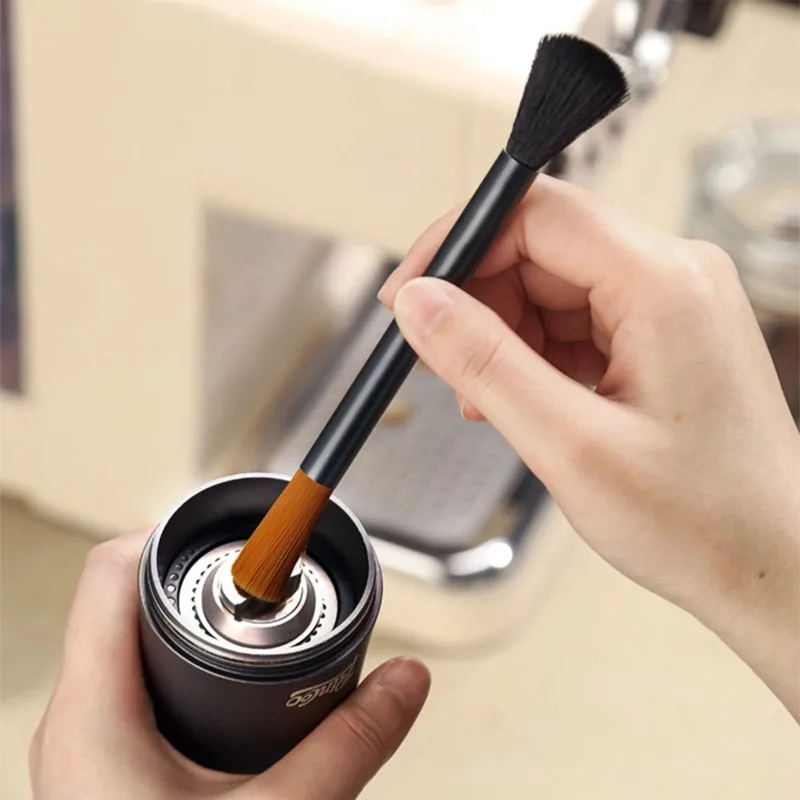
A dedicated tool like the Coffee Bar Counter & Grinder Cleaning Brush is an essential low-cost accessory. Regular maintenance takes only a minute: use a soft-bristle brush to sweep away loose grounds from the burr carrier and chute after every few bags. Avoid running water through metal burrs or motorized chambers unless the manufacturer's manual explicitly states the components are dishwasher-safe and rust-resistant.
How to Dial In Your Grind Setting
Because grinder collar numbers and tick marks are not standardized across manufacturers, treat all grind charts as directional starting points. Dialing in is simply matching particle resistance to your chosen brew method:
- Start at the recommended baseline: Fine for espresso, medium-fine for pour-over, medium for batch drip, and medium-coarse for French press.
- Observe brew flow: In espresso, a shot that gushes out in under 15 seconds is too coarse; a shot that chokes the machine is too fine. In pour-over, water pooling indefinitely indicates excessive fines clogging the filter paper.
- Taste and adjust: If your cup tastes sharp, sour, and thin (under-extracted), adjust one to two clicks finer to slow down water flow and increase surface area. If your cup tastes dry, astringent, and unpleasantly bitter (over-extracted), move coarser.
Buyer Verification Checklist Before Ordering
- Voltage and Plug Type: For electric models (such as the Wancle or HiBREW G5), confirm whether the variant selected in your cart matches your country's standard (110V/120V US plug vs 220V/240V EU/UK plug).
- Burr Material & Replacement: Check whether the burr set is stainless steel or ceramic. Stainless steel burrs stay sharper longer and crush hard beans with less wobble, while ceramic burrs are common in entry-level manual mills.
- Batch Size Requirements: If you brew large carafes (60g+ of beans) every morning, hand grinders with 25g capacities will require two to three consecutive manual cycles. Choose an electric hopper mill instead.
- Espresso Capability: True unpressurized espresso requires microscopic adjustments. Verify whether the grinder offers stepless or micro-click adjustments rather than coarse, wide steps.
Note: Product pricing and listing specifications reflect seller marketplace information captured in October 2026. Final voltage variants, accessories, and warranty coverage should be confirmed directly on the seller page prior to purchase.